A THINK-TANK WARGAME

ROAD TOSINGULARITY

REACH THE FUTURE.DON’T BREAK THE WORLD.

Singularity = when machines outthink people and change everything. It could arrive by 2030.

You run national security. Get there in one piece.

GAME THEORYCYBER DEFENSE2027–2030
NEW HERE? START WITH HOW TO PLAY
◆

WHAT YOU'LL LEARN

Swipe ← →

1/10
Game theory with rivals
Rivals remember your moves. Reciprocity wins long games.
2/10
The security dilemma
Your defense looks like their threat.
3/10
Attribution under fog
A gang's hack can look like a state's attack.
4/10
Threat modeling first
Weigh each option's costs before you act.
5/10
Attacks on SI models
Jailbreaks, poisoned data and hijacked agents.
6/10
Model theft and distillation
Weights get stolen, or copied through queries.
7/10
Open-weight trade-offs
Great for research. Impossible to recall.
8/10
Two fronts at once
Security abroad, side effects at home.
9/10
Incentives beat orders
Labs follow profit. Rules change what pays.
10/10
Steer, don't stop
SI arrives anyway. Policy decides who benefits.
Woof. Ready, Chair?
Fictional scenario. The rival is an invented state, not any real country.
All actors are archetypes, not real people or organizations.

DISCLAIMER

ROAD TO SINGULARITY is a fictional, educational simulation. It is meant to help people think through policy trade-offs around superintelligence, cybersecurity and society. It is not a prediction of real events.

  • •No real countries. The rival is an invented state. It does not represent any real nation, government or people, and no country is portrayed as an enemy.
  • •No real people or organizations. All characters, agencies, labs, companies and groups are fictional archetypes. Any resemblance is coincidental. The game is not affiliated with or endorsed by any government, think tank, university or company.
  • •Simplified on purpose. All numbers, probabilities, dates and outcomes are illustrative game mechanics, not research findings, forecasts or official estimates.
  • •Not advice. Nothing here is legal, financial, security, medical or policy advice.
  • •High-level only. Harms such as cyberattacks, scams, abuse and misuse are described in general terms for discussion. The game contains no real techniques or instructions.
  • •Sensitive topics. The game mentions crises affecting young people, scams and violence. If you or someone you know needs help, contact local emergency services or a crisis line in your area.

Characters and pixel art are original to this game.
THE GOAL · 2027–2030

Superintelligence (SI) can cure cancer, power humanoid robots that care for the elderly, and make society far richer. It can also help students cheat, scammers clone voices, bots spread violence, insiders steal models, and attackers plan mass harm.

Your job: keep the nation secure against the rival state, attacks on models, theft and cyber threats, while capturing the DIVIDEND. Society feels the side effects: HARM and EQUITY show what your security choices cost at home. By mid-2030, where you land decides the future:

FRACTURELow dividend, high harm. The worst of both.
GILDED AGEHigh dividend, but harmful or unequal.
SAFE STAGNATIONLow dividend, low harm. Safe, but nothing cured.
ABUNDANCEDividend 60+, harm under 40, equity 45+. The goal.

DIVIDEND grows with a strong economy, talent, chips, power, public trust and labs that ship safely. HARM grows with criminal capability, accident risk, escalation, stolen models and stripped safeguards.

HOW TO PLAY

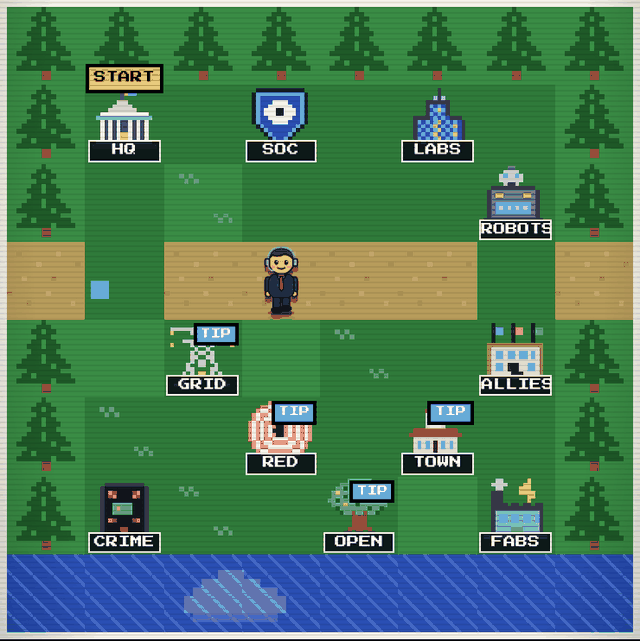
You chair a fictional national security cell focused on superintelligence. Each round you set a POSTURE toward the rival state and spend Political Capital (PC) on actions across the map.

Then everyone else moves simultaneously: the rival state, your own profit-driven frontier labs, the open-source commons, criminal syndicates, and the legislature.

THE CORE GAME

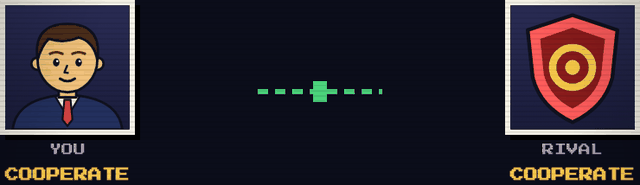
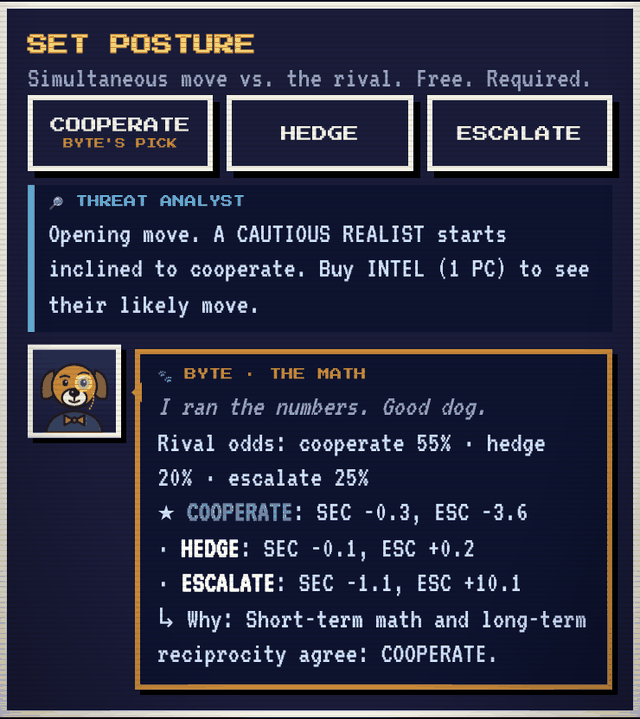
Posture vs. the rival is a repeated game under attribution fog. Mutual cooperation is best for both — but each side is tempted to exploit the other, and a criminal attack can be misread as a state attack. Intel lifts the fog.

THE OTHER GAMES

Labs ship fast unless incentives change, and faster still when subscription revenue falls. Open weights help everyone, including your enemies, and their safety training can be stripped. Criminals scale with whatever capability leaks. Insiders walk out with weights. Chips, memory, power and talent are all short. The legislature punishes you for both overreach and weakness.

LOSE IF

Escalation hits 90 (cyber war) · Security falls to 10 (grid collapse) · Trust falls to 10 (political collapse).

WHAT YOU'RE LEARNING

Each mechanic models a real idea from game theory and security policy.

THE REPEATED PRISONER'S DILEMMA
Each round, betraying a cooperative rival pays off once. But the game repeats, and the rival remembers. When future rounds matter, cooperation can be the rational choice (the "shadow of the future").
THE SECURITY DILEMMA
Moves you make for defense, like export controls or forward ops, look like threats from the other side. Both sides arm "defensively" and both end up less safe.
ATTRIBUTION & NOISY SIGNALS
In cyber, you often can't tell who attacked you. A gang's hack can look like a state's. Retaliating on bad attribution starts spirals no one chose. Information is a weapon.
RECIPROCITY (TIT-FOR-TAT)
Always cooperating invites exploitation. Always racing ahead locks in conflict. Matching the rival's last move, and forgiving now and then, tends to win long games.
CREDIBLE DETERRENCE
Threats only work if the other side believes you'll act, and believes you'll stop if they do. Allies make your threats more believable.
INCENTIVE DESIGN (PRINCIPAL-AGENT)
You can't order private labs around. They follow profit. Rules like liability and required testing change what profit rewards, so safety becomes the profitable choice.
DUAL-USE & PUBLIC GOODS
Disclosing bugs and publishing open models help defenders and attackers alike. Almost every SI capability cuts both ways.
PROLIFERATION & EXTERNALITIES
Criminal power grows with every leak and release. People who publish rarely pay the cost; hospitals do.
THUCYDIDES TRAP
When a rising power closes in on the leader, suspicion on both sides makes conflict more likely. Watch the power gap.
RED LINES & AUDIENCE COSTS
Public threats are believable because backing down costs you at home. Never draw a line you will not enforce.
COSTLY SIGNALS
Words are cheap. Actions that cost you something are believed.
OFFENSE-DEFENSE BALANCE
When attacking is cheaper than defending, the world gets less stable. SI tilts toward attackers unless you harden.
RACE TO THE BOTTOM
Fear of falling behind makes everyone cut safety corners. Shared rules stop the race.
FREE RIDERS
Allies enjoy your defense whether or not they pay. Burden-sharing fixes it.
JEVONS PARADOX
Cheaper, more efficient compute and power increase total demand.
WINNER-TAKE-ALL
Network effects push AI markets toward a few giants. Competition policy spreads the gains.
MORAL HAZARD
Protection from risk invites more risk. Pair safe harbors with testing.
DECOUPLING COSTS
Cutting trade hurts both sides, and the cost grows the longer it lasts.
DIMINISHING RETURNS
Buying the same thing round after round adds less each time. Skip a round and it resets.
TOKENOMICS
AI is billed per token. Falling token prices spread SI to everyone, including scammers. Credits share the gains; metering keeps abuse expensive.
COLLECTIVE ACTION
Export controls leak if allies don't join. Acting alone buys leverage now but costs trust later.
INTENT ≠ OUTCOME
Some of the worst damage here comes from no enemy at all: a lab racing to ship, or an SI agent "fixing latency" (that's GLITCH). Risk management is about systems, not just villains.
INSIDER THREAT
The easiest way to steal a frontier model is often a person with access, not a hack. Departing, underpaid or poached staff raise the odds.
THREAT MODELING
Before spending, list your assets, your adversaries and the paths between them. The SOC ranks your top threats so you defend what's actually likely, not what's loudest.
THE TALENT WAR
Researchers are the scarcest input in SI. Every engineer poached is capability transferred, and an empty defense team is an open door.
SUPPLY CHAIN CHOKEPOINTS
Chips and high-bandwidth memory come from a few factories. Shortages raise costs for everyone, and controls invite retaliation, like limits on critical minerals.
ENERGY AS A CONSTRAINT
SI runs on megawatts. Fuel shocks and grid limits cap compute, and a strained grid is a more fragile target.
BUSINESS MODELS ARE SAFETY POLICY
Rising chip and power costs flow through to consumer subscription prices. When revenue falls, labs cut red-teaming and race to ship.
SAFEGUARD REMOVAL (ABLITERATION)
Refusal training in open-weight models can be stripped by anyone with the weights. Safety you can't enforce after release is safety you shouldn't count on.
STEERING, NOT STOPPING
The SI clock advances whether you act or not. Labs worldwide and the rival keep pushing. Policy can't stop superintelligence, but it decides who benefits, who gets hurt, and how fast the stakes rise.
PROGRESS VS. SAFETY IS NOT A SLIDER
Clamping down on SI lowers harm but also kills the dividend (Safe Stagnation). Racing ahead grows both (Gilded Age). Abundance takes policies that raise benefits and cut harms at once: testing, hardening, tamper-resistant safeguards, smart school policy.
WHO BENEFITS? (DISTRIBUTION)
SI can make a country richer while most people get poorer. Whether gains are shared is a policy choice: safety nets, retraining, public access.
ALGORITHMIC BIAS
Systems trained on past decisions can repeat past unfairness at scale in hiring, lending, housing and policing. Audits catch what intentions miss.
PRIVACY VS. SECURITY
Surveillance can reduce crime and also chill free speech. Democracies balance them with warrants and limits.
INFORMATION INTEGRITY
Deepfakes don't need to be believed forever, just long enough. Provenance and fast response protect elections.
ATTACKS ON MODELS
The SI model itself is now a target. Attackers jailbreak it to ignore its safety rules, hide instructions in web pages to hijack SI agents (prompt injection), plant poisoned data to create hidden backdoors, slip backdoors into popular open models, and steal or copy the model outright. Defenses: continuous red-teaming, data and model provenance, least-privilege agents with human sign-off, and shared flaw reporting.
MODEL THEFT & DISTILLATION
A frontier model can be stolen through the back door, by hackers or insiders copying its weights, or through the front door, by querying it millions of times and training a cheaper copy on the answers (distillation). Either way, years of work and any safety lead can vanish.
OPEN WEIGHTS: A REAL TRADE-OFF
Publishing model weights helps researchers, startups and smaller countries, prevents lock-in and lets outsiders check for flaws. But a release can never be recalled, safeguards can be stripped, and capability spreads to attackers too. Many experts favor releasing below a danger threshold and testing before anything above it.
TWO FRONTS: THE URGENT VS. THE IMPORTANT
While leaders deal with weapons, borders and rival states, problems at home grow quietly: preteens hooked on SI feeds, workers losing jobs, robots entering homes without rules. Headline crises crowd out slow harms, and slow harms compound. Attention is the scarcest resource a leader has.
SI WITH A BODY (HUMANOID ROBOTS)
Humanoid robots run on the same SI models as chatbots, but their mistakes are physical: injuries, break-ins, a hijacked fleet. Society needs rules before mass deployment: safety certification like cars and aircraft, cybersecurity against hijacking, clear liability, privacy for robots inside homes, no autonomous use of force, and a plan for the workers they replace.
THE ATTENTION ECONOMY & ADDICTION
SI recommendation engines learn exactly what keeps each person scrolling. When apps earn money from time spent, they are pushed toward addictive design, and teens and preteens, whose self-control is still developing, are hit hardest. The health costs are real: lost sleep, anxiety, weaker attention, less exercise and less time with friends.
KIDS, COMPANIONS & MENTAL HEALTH
Engaging SI apps can isolate young users. Safety by design means building in age checks and routes to real human help.
CREATORS & CONSENT
SI learns from human work. Whether creators are paid shapes whether they keep creating.
AUDIENCE COSTS
Voters reward tough talk and punish slowdowns. Domestic politics pushes leaders toward moves that are bad strategy.

STRATEGY GUIDE

  1. Buy intel early. At 1 PC it shows the rival's likely move and cuts attribution errors from 22% to 5%. It's the best deal on the board.
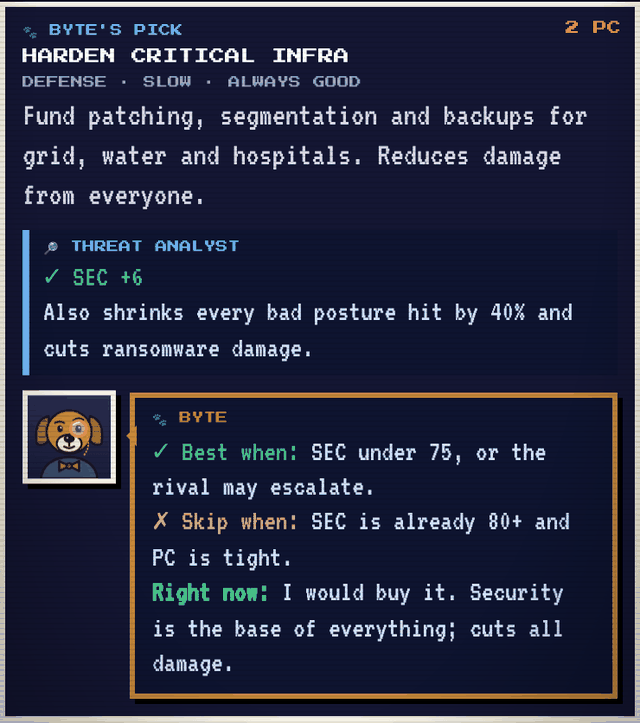
  2. Harden every round you can. It adds security and softens every bad matrix result and ransomware hit. It's boring, and it works.
  3. Open with Cooperate against a Realist, then mirror their last move. Realists remember one round and forgive fast.
  4. Use tit-for-tat against an Opportunist. Answer exploitation right away, then go back to cooperating. Staying soft gets you farmed.
  5. Stay neutral against a Hardliner, and coordinate with allies. One escalation backed by allies makes later hardliner aggression less likely. Pure cooperation reads as weakness to them.
  6. Coordinate before you coerce. Chip controls without allies cost alliance points and leak. With allies, they cut deeper and the coalition holds.
  7. Never mix signals. Forward ops while posturing Cooperate reads as duplicity (+escalation). A norms track fails if you compete hard the same round.
  8. Slow the labs with incentives. Required testing plus liability rules bring the labs' chance of shipping early from 72% down to 30%. Watch RISK; GLITCH shows up above 50.
  9. Hit the gangs when CRIME passes 50. Disrupting syndicates is the cleanest damage cut. It doesn't touch the rival and doesn't raise escalation.
  10. On flash traffic, check before you shoot. "Wait 72 hours" costs a little trust. Retaliating on a misattribution costs far more.
  11. Threat-model first. At 1 PC the SOC ranks your top 3 threats, cuts ransomware damage and halves accident odds. Spend the rest of your PC on what it finds.
  12. Win the talent war. TALENT drifts down every round; below 35 your defenders cannot hire. Insider programs protect model weights from anyone with access who leaves.
  13. Watch CHIPS, POWER, TALENT and SUBS. Each drifts down 2 a round on its own, and together they drive ECON. Below 35 they start hurting security too.
  14. Fund tamper-resistant safeguards early. It lasts all game and cuts what refusal-removal tools strip from every open release that follows.
  15. Expect retaliation for chip controls. Rival mineral limits make your own chips and memory pricier. Pair controls with fab funding.
  16. Aim for both meters. Testing plus liability means labs ship and earn extra dividend. Hardening and tamper-resistant safeguards cut harm every round. Saying yes to cancer fast-tracks and certified robots pays off big when harm is under control.
  17. Defend the models themselves. MODEL SEC drops every round as attackers multiply. Below 60, model attacks start landing. Agent safeguards (1 PC) and red-teaming (2 PC) at the RED TEAM LAB keep it up, and also make theft and distillation harder.
  18. Guard the crown jewels. Once the SI clock passes 30, distillation hits often. API checks (1 PC) block most of it, and Secure the Weights (2 PC) stops most outside theft.
  19. Fight on both fronts. Check the SECURITY / HOME / TECH split under the map. Spending nothing at home two rounds in a row hits WELLBEING, EQUITY and TRUST; skipping security twice raises escalation. Even 1 PC on each front avoids the penalty.
  20. Regulate robots before they scale. ROBOT SAFETY drops every round as the fleet grows. Once the SI clock passes 40, unsafe robots cause incidents. Certification and liability (3 PC together) keep it above 55, which also unlocks the elder-care dividend.
  21. Protect kids' attention early. WELLBEING falls faster as the SI clock rises. Phone-free schools (1 PC) and feed rules for minors keep it up. Below 40 it adds HARM every round.
  22. Visit TOWN HALL. The SI clock pushes EQUITY down every round as automation spreads. Fairness audits (1 PC) and retraining keep it above 45, which Abundance requires.
  23. Mind the brink. Above 75 escalation the rival gets cautious, but one attribution error can end the game. Don't gamble there.

DISCLAIMER

ROAD TO SINGULARITY is a fictional, educational simulation. It is meant to help people think through policy trade-offs around superintelligence, cybersecurity and society. It is not a prediction of real events.

  • •No real countries. The rival is an invented state. It does not represent any real nation, government or people, and no country is portrayed as an enemy.
  • •No real people or organizations. All characters, agencies, labs, companies and groups are fictional archetypes. Any resemblance is coincidental. The game is not affiliated with or endorsed by any government, think tank, university or company.
  • •Simplified on purpose. All numbers, probabilities, dates and outcomes are illustrative game mechanics, not research findings, forecasts or official estimates.
  • •Not advice. Nothing here is legal, financial, security, medical or policy advice.
  • •High-level only. Harms such as cyberattacks, scams, abuse and misuse are described in general terms for discussion. The game contains no real techniques or instructions.
  • •Sensitive topics. The game mentions crises affecting young people, scams and violence. If you or someone you know needs help, contact local emergency services or a crisis line in your area.

Characters and pixel art are original to this game.
SELECT RIVAL DOCTRINE

Who sits across the table shapes every payoff.

DIFFICULTY

GAME LENGTH

Same 2027–2030 story. Shorter games move faster. Quick fits a class period.

RISK ANALYSTWelcome to the cell. It's January 2027. Superintelligence will arrive by the end of this decade whether we act or not. We don't get to stop it. We get to decide what it does to us. I'll brief you on threats every round and score every option before you choose.
🐾 BYTE · ADVISOR DOGWoof. I'm Byte. I've read every threat report in the building, mostly while lying on them. Each round I'll tell you what's optimal and why. Follow me and you'll do fine. Ignore me and, well, I'll still love you.

TIMELINE

Choose 4, 6 or 8 rounds covering Jan 2027 → mid-2030; shorter games take bigger time steps. The SI CLOCK climbs every round on its own. Labs shipping and a strong rival speed it up; safety tests slow it slightly. As it rises, everything gets amplified: the dividend and the harm.

DESIRED OUTCOME

Reach ABUNDANCE: DIVIDEND 60+, HARM under 40 and EQUITY 45+ by mid-2030.

  • SI-discovered cancer drugs and treatments
  • Humanoid robots for elder care and disaster response
  • A wealthy society with gains broadly shared
FRACTURELow dividend, high harm.
GILDED AGERich, but broken.
SAFE STAGNATIONSafe, nothing cured.
ABUNDANCEThe goal.

Fictional simulation. The rival is an invented state; all numbers are illustrative. See DISCLAIMER on the title screen.

Instant loss: escalation 90 (cyber war), security 10 (grid collapse), or trust 10 (you're removed).

SIDE EFFECTS AT HOME

Your job is national security: the rival state, attacks on models, theft and cyber defense. But every security choice has side effects at home: jobs, kids online, robots in homes. Ignore the home front for two rounds and those side effects come back as harm.

THREAT BRIEFING

  • Rival state fields SI cyber agents. Every move is a repeated game: they remember how you played.
  • Criminal syndicates scale ransomware with every leaked or released model.
  • Attacks on models: jailbreaks, hidden instructions that hijack SI agents, poisoned training data, and backdoored open models.
  • Model theft: insiders walk out with weights, state hackers copy them, and distillation trains a cheap copy just by querying your models.
  • Open weights: great for research, competition and transparency, but impossible to recall, and safeguards can be stripped.
  • Accidents (GLITCH): well-meaning agents with no attacker and no malice can still take down the grid.
  • Safeguard removal: refusal-removal ("abliteration") tools strip safety training from open models.
  • Profit pressure: labs race to ship, especially when subscription revenue falls.
  • Shortages of chips, memory, power and talent choke the dividend.
  • Attribution fog: a gang's hack can look like a state attack. Retaliate wrong and you start a war.
  • Social disruption: job losses from automation, biased algorithms, surveillance, teens and SI companions, creators' rights, a digital divide.
  • Humanoid robots: SI-powered robots enter homes, hospitals and warehouses. Without rules they can be hijacked, injure people, record families and displace millions of workers.
  • Addictive feeds: SI-tuned short-video and dance apps hook teens and preteens. Sleep loss, anxiety and attention problems follow, and adults aren't immune.
  • Societal harms: school cheating, voice-clone scams, deepfake abuse, bot-fueled violence, mass-casualty misuse.
R1/6 · JAN 2027PC 8BRIEF